
A canon-backed Mikasa Ackerman character guide covering her personality, origin, best arcs, relationships, and why Attack on Titan fans still obsess over her.
Mikasa Ackerman from Attack on Titan: Appearance, Personality, Best Scenes, and Why Fans Still Love Her
Mikasa Ackerman is one of those anime characters who gets flattened into “strong girl with a scarf” way too easily, which feels almost disrespectful to how carefully Attack on Titan actually built her. What lasts about Mikasa is not just the red scarf, the blades, or the cool stare. It is the way Hajime Isayama turns survival into personality. She is disciplined because the world was cruel early. She is lethal because hesitation got punished early. She is loving in this almost unbearable way because she knows exactly how fast love can be taken from you.
I think that is why Mikasa still lands so hard even after years of edits, posters, and “best girl” arguments. She is not just stylish. She is emotionally compressed. You can feel whole arcs of fear, loyalty, grief, and restraint in one look from her, which is why she still feels bigger than the very simple visual ingredients that make her iconic.
Quick Answer
Mikasa Ackerman is one of the central heroines of Attack on Titan, an elite Survey Corps soldier known for extraordinary combat skill, stoic focus, and a deep emotional bond to Eren Yeager. Fans still love her because she combines instantly recognizable design, frightening competence, tragic loyalty, and one of the strongest protector archetypes in modern anime.
Character Snapshot
| Series | Attack on Titan |
|---|---|
| Role | Survey Corps soldier / main heroine |
| Affiliation | Survey Corps |
| Voice actor | Yui Ishikawa |
| Signature traits | Stoic, protective, disciplined, lethal in combat, deeply loyal |
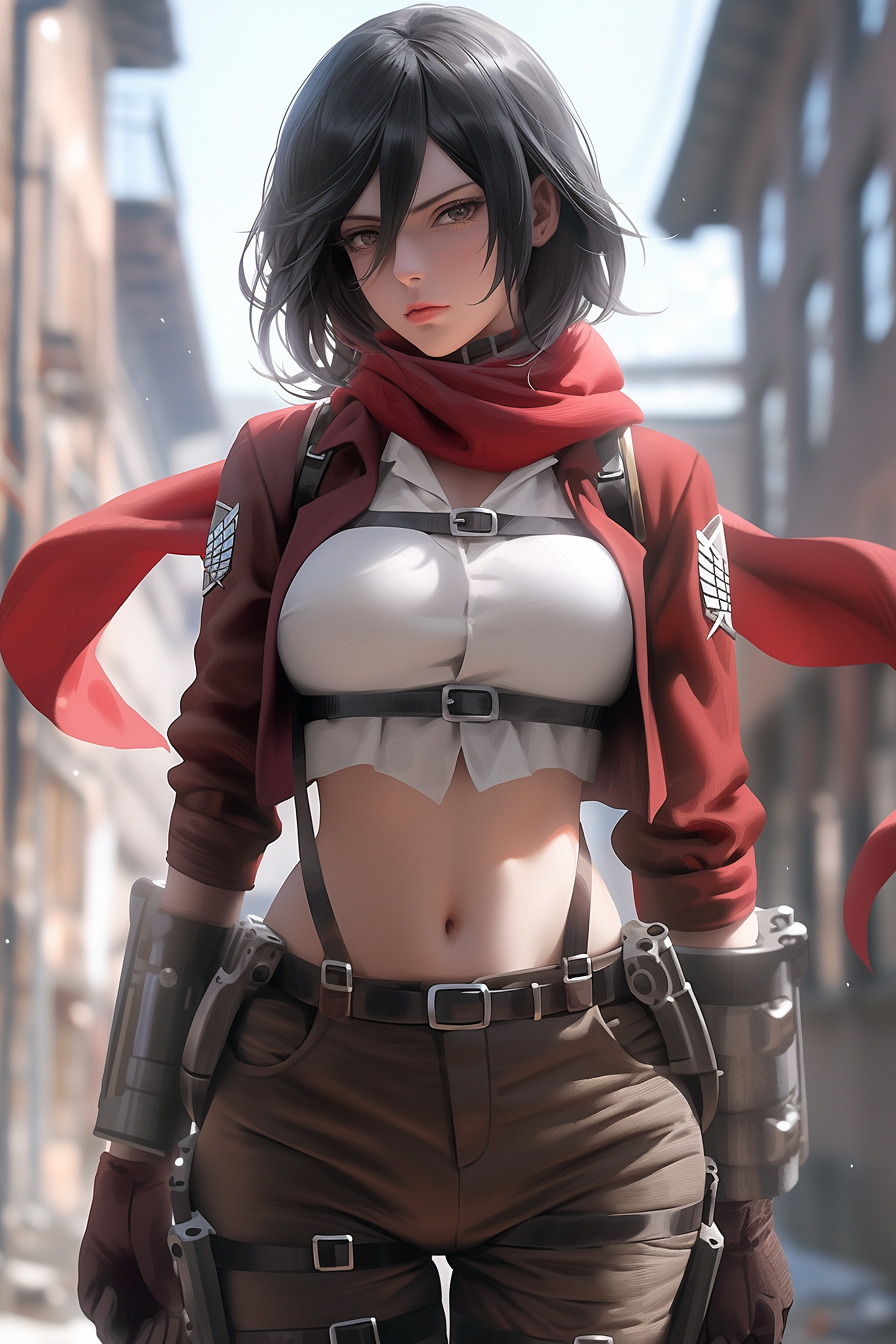
| Signature look | Black hair, gray eyes, red scarf, ODM gear, Survey Corps uniform |
| Core relationship | Eren Yeager |
| Family line | Ackerman clan / Asian heritage from her mother side |
Who Mikasa Is in Canon
The official franchise material presents Mikasa as one of the most important characters in Attack on Titan, not just because she is strong, but because she stays steady in a story that keeps trying to destroy every stable bond it creates. She is a childhood-trauma survivor, one of the most gifted soldiers in the cast, and one of the emotional anchors the series keeps returning to when it wants to talk about attachment, violence, and loss.
What matters most is that Mikasa is never actually written like a generic cool fighter girl. Her stillness, fear, restraint, and devotion are all part of the same structure. She can look almost emotionally sealed in one scene and absolutely wrecked in the next. That contrast is exactly why she survived the first wave of Attack on Titan hype and kept feeling important long after louder characters entered the discourse.
What Mikasa Looks Like and Why the Design Works
Mikasa’s design is incredibly effective because it is simple enough to read instantly and specific enough to feel mythic. Black hair, gray eyes, a serious expression, Survey Corps gear, and the red scarf are enough to make her recognizable from a thumbnail, a silhouette, a wallpaper crop, or a merch stand from across the room.
The scarf is the real key. It makes Mikasa feel like a character with a symbol, not just a face. It is warmth, memory, rescue, and emotional dependence all wrapped into one visual object. Even when the story gets louder, darker, and more chaotic, that scarf keeps her identity emotionally legible.
Mikasa’s Personality
Mikasa is stoic, hyper-alert, and usually the calmest person in the room when everyone else starts breaking apart. But that calm is not emptiness. It is discipline built on fear, grief, and the need to stay in control after one catastrophic loss rewired her whole life.
She is also deeply protective, which fandom sometimes flattens into one-note obsession when the actual writing is much broader than that. Mikasa protects tactically and emotionally. She is the person who sees danger first, moves first, and often carries the emotional cost of surviving first.
- She is blunt rather than performative.
- She is loyal to the point of self-erasure.
- She can be frighteningly efficient in combat.
- She rarely wastes emotion, which is why her softer scenes hit so hard.
Origin Story and Timeline
Early childhood
Mikasa’s early life is defined by the murder of her parents and the violent moment that forces her to fight in order to survive. That trauma is the source point for almost everything fans later read as her emotional style. She does not become guarded by accident. She becomes guarded because the world taught her exactly what happens when you are not.
Meeting Eren
Eren rescuing her and wrapping the scarf around her is one of the defining symbolic moments in the whole series. It is not just a sentimental memory. It becomes the object around which a huge amount of Mikasa’s emotional identity keeps rotating.
Training and the Survey Corps
Her growth through military training and later Survey Corps service is what turns her from a traumatic backstory into a practical force inside the plot. The series repeatedly frames her as one of the strongest soldiers of her generation, and that strength is never decorative. It changes outcomes.
The long arc
As the story develops, Mikasa stays central because she is one of the few characters who can carry both action pressure and emotional memory at the same time. The final stretch of Attack on Titan matters because it completes the loop between love, violence, freedom, and the unbearable cost of holding onto someone when the whole world has changed shape around you.
Relationships
Eren Yeager
Eren is the relationship most people think of first, and for good reason. He is the person who saved her, gave her the scarf, and changed the trajectory of her life. The series keeps returning to that bond because it is built out of both protection and pain.
Armin Arlert
Armin matters because he is one of the few people who can reach Mikasa without forcing every scene into pure confrontation. Their relationship proves she is not only defined by one emotional axis.
Levi Ackerman and the Ackerman line
The Ackerman bloodline matters inside the series and in fandom. Mikasa’s connection to Levi adds another layer of discussion around inherited power, combat instinct, and the near-mythic status both characters carry.
The Survey Corps
Mikasa also works because she is not just a lone killer. She is a team character inside the Survey Corps structure. That context matters because it places her power inside a larger military and moral frame instead of turning her into a floating action ornament.
What Mikasa Wants and What She Fears
Canon-backed desire: to protect the people she loves and survive in a world that keeps punishing attachment.
Series-strongly-suggested fear: losing the person she is most emotionally tied to and being left with the knowledge that strength cannot solve grief.
That tension is why Mikasa resonates so hard. She is not built around speeches. She is built around the cost of caring in a world that keeps giving her reasons to shut down instead.
Small Details Fans Search For
- Signature item: the red scarf
- Voice actor: Yui Ishikawa
- Common visual markers: black hair, gray eyes, Survey Corps uniform, ODM gear
- Family line: Ackerman clan
- Widely discussed detail: her tattoo or mark from her mother’s side and her partial Asian heritage
- Officially clear fact: she is one of the central soldiers in the Survey Corps, not a side character
If a page wants to claim ultra-specific trivia like favorite foods or private hobbies, it should say whether that came from official guide material or just fandom repetition. Mikasa’s actual canon pressure is already more interesting than fake trivia padding.
Best Scenes and Arcs
- Trost District: where her survival instincts and combat identity fully lock in
- Female Titan arc: one of the clearest reminders that Mikasa is not support furniture, she is a real threat
- Return to Shiganshina: where the emotional and tactical stakes both spike
- The Final Season and final chapters: where her story moves from protection toward painful resolution
The official franchise has highlighted Mikasa again and again in final-season coverage, music tie-ins, and premium merch. That is not an accident. She is one of the pillars the whole brand still leans on.
Why Fans Still Obsess Over Mikasa
Because she is built around a fantasy fandom never really gets tired of: the quiet, deadly protector who does not need to perform confidence because competence is already built into her body language. That plays perfectly across cosplay, edits, wallpapers, posters, and every version of anime-character SEO that depends on instant recognition.
She also works because she is not purely cold. There is grief there. There is tenderness there. There is a visible longing to keep one person safe in a world that refuses to stay safe. That makes her easy to admire and very hard to flatten all the way down.
Best Next Clicks by Search Intent
- Want the full Attack on Titan on-ramp? Start with the Attack on Titan anime hub, which now routes more cleanly through Mikasa, Eren, the franchise visual lane, and the broader Survey Corps stack.
- Want the Mikasa-only image route? Jump to Mikasa wallpapers, posters, and PFPs for the sharp-scarf, blade-dance, and best-girl visual lane.
- Want the franchise-wide image route? Open Attack on Titan wallpapers, posters, and PFPs for the broader Survey Corps, Titan-scale, and endgame-moodboard lane.
- Want the closest character follow-on route? Read Eren Yeager for the central tragedy lane and Levi Ackerman for the cleanest veteran-protector follow-on.
- Want the broader waifu and avatar-browsing lane? Keep going through Top 100 Anime Waifus and Anime PFPs.
What I Actually Think About Her
I think Mikasa is one of the best examples of minimalist design creating maximum fandom memory. She does not need giant speeches to feel huge. She needs a scarf, a stare, a blade, and a story that keeps asking what loyalty costs. That is enough.
For this site, she is also one of the strongest mature-cluster anchors in the entire Attack on Titan lane. The live character guide, dedicated visual page, franchise hub, and franchise visual router are all already mapped cleanly, so tightening the in-page handoffs strengthens the whole cluster without forcing any slug or permalink risk.
If You Like Mikasa, Read These Next
- Attack on Titan Anime Guide
- Attack on Titan Wallpapers, Posters, and PFPs
- Eren Yeager from Attack on Titan
- Top 100 Anime Waifus
- Anime PFPs
FAQ
Who is Mikasa Ackerman?
Mikasa Ackerman is one of the main heroines of Attack on Titan and an elite soldier in the Survey Corps.
Why is Mikasa so popular?
Because she combines iconic design, combat strength, emotional restraint, loyalty, and one of anime’s clearest protector archetypes.
What is Mikasa’s voice actor?
Mikasa is voiced by Yui Ishikawa in the Japanese anime.
What does Mikasa want most?
She wants to protect the people she loves and survive without losing herself to the violence around her.
Why do fans remember the scarf so much?
Because it is both a literal object and the emotional symbol of her connection to Eren, safety, memory, and attachment.
Sources and Reference Pages
- Official The Last Attack introduction
- Official The Last Attack box office milestone page with Mikasa wallpaper
- Official Mikasa and Jean message ring news page
- Official Attack on Titan silver ring news page featuring Mikasa
- Official Mikasa message ring news page
- Official Season 2 Blu-ray page with cast credits
- Attack on Titan Wiki: Mikasa Ackerman
Leave a Comment